Cracking the Chemistry Behind Cleaner Water
Water treatment is rarely viewed through the same lens as transport infrastructure, construction equipment or industrial expansion, yet it remains one of the most important enabling systems in the modern economy. Every city, industrial zone, logistics network and manufacturing facility depends on reliable access to clean water and effective wastewater management. As populations expand and environmental expectations increase, treatment operators are under growing pressure to remove more contaminants, consume fewer resources and deliver better outcomes from infrastructure that, in many cases, already operates close to capacity.
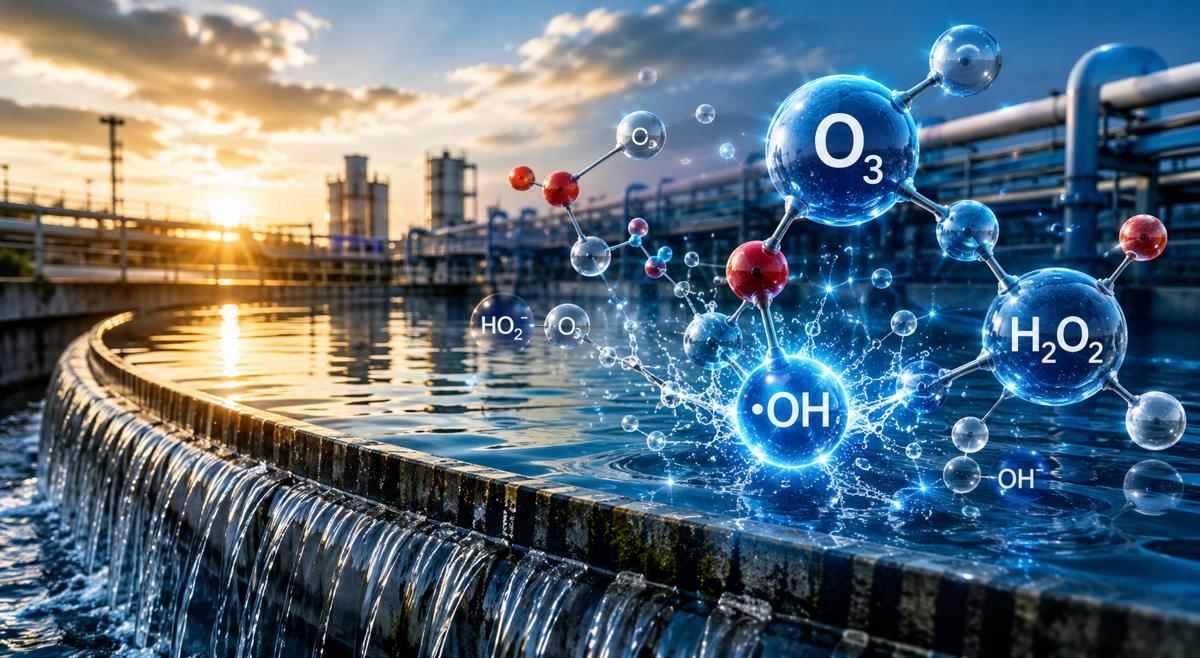
That balancing act has accelerated interest in technologies capable of improving treatment performance without necessarily requiring larger facilities or entirely new processes. Advanced oxidation processes have emerged as one of the more important developments in this space because they focus on destroying contaminants chemically rather than simply separating them from water. Among these technologies, ozone has established itself as one of the industry’s most widely adopted treatment tools. It has been used across drinking water and wastewater applications for decades because it can both directly oxidise contaminants and generate highly reactive hydroxyl radicals that continue the treatment process through secondary reactions.
Introducing hydrogen peroxide into that chemistry creates what is commonly known as the peroxone process, one of the best-established advanced oxidation systems currently used in water treatment. Operators have long understood that combining ozone and hydrogen peroxide often improves contaminant removal and treatment efficiency. What has remained less clear is exactly why the chemistry performs as well as it does and whether current engineering assumptions accurately reflect what is happening inside treatment systems.
New research from Harbin Institute of Technology suggests the answer may be no. According to the findings, one of the sector’s most established oxidation processes appears to generate significantly more productive chemistry than previous models suggested, offering engineers and operators a clearer framework for improving treatment performance.
Briefing
- Researchers revisited the accepted mechanism governing ozone and hydrogen peroxide oxidation reactions.
- The peroxone process generated a stable hydroxyl radical yield of approximately 67 percent.
- Electron transfer was identified as a major initiation pathway alongside oxygen atom transfer.
- Findings may support more accurate oxidant dosing and stronger treatment efficiency.
- The research creates a more practical engineering model for ozone-based purification systems.
Modern Water Treatment Needs More Precision Not More Chemistry
Water treatment is becoming increasingly complex because the contaminants entering systems are changing faster than infrastructure itself.
Traditional treatment methods remain highly effective for suspended solids, pathogens and many common pollutants, but operators are increasingly dealing with contaminants that behave differently. Pharmaceuticals, agricultural chemicals, industrial compounds and persistent organic pollutants often remain stable through conventional treatment stages and require more aggressive intervention to achieve acceptable outcomes.
Advanced oxidation processes were developed to address precisely this challenge. Rather than capturing contaminants physically, these systems generate highly reactive chemical species that attack molecular structures directly and break them into simpler compounds. Within that category, ozone has become particularly attractive because it offers multiple treatment mechanisms operating simultaneously.
Some compounds react directly with dissolved ozone. Others are degraded through secondary oxidation chemistry generated as ozone decomposes in water. Those secondary reactions create hydroxyl radicals, among the most reactive oxidising species available in water treatment applications.
The effectiveness of advanced oxidation systems therefore depends on more than simply how quickly ozone disappears. The critical question is how efficiently consumed ozone becomes useful oxidation capable of removing contaminants.
Historically, that distinction has not always been fully reflected in treatment models.
Looking Beyond Ozone Consumption
The research team, consisting of Yishi Wang, Wei Qiu, Yongbo Yu and Jun Ma from the State Key Laboratory of Urban Water Resource and Environment at Harbin Institute of Technology, focused their work on understanding the earliest stages of ozone-driven oxidation.
Published in Environmental Science and Ecotechnology, the study set out to revisit assumptions that have influenced understanding of peroxone chemistry for years. Previous explanations suggested that reaction initiation depended heavily on intermediate adduct formation and implied that radical generation remained relatively limited.
That assumption created a practical problem because treatment performance often appeared stronger than theoretical models predicted.
To investigate further, the researchers combined radical capture experiments, competition assays and quantum chemical modelling. Their objective was not simply to observe ozone decay but to determine how efficiently ozone generated hydroxyl radicals under different operating conditions.
The team measured how pH and hydrogen peroxide concentration influenced both ozone decomposition and pollutant degradation. Compounds including atrazine and p-chlorobenzoic acid were used as indicators because their behaviour provides insight into hydroxyl radical activity during treatment.
This combination of experimental observation and theoretical analysis allowed the researchers to move beyond broad assumptions and examine how oxidation reactions actually begin.
A More Consistent Radical Yield Than Expected
One of the clearest outcomes from the study was the consistency of radical generation under peroxone conditions.
The researchers found that increasing pH increased hydroxyl radical exposure during ozone-only treatment. However, introducing hydrogen peroxide produced a more reliable route to radical generation under near-neutral conditions that more closely resemble practical operating environments found across water treatment infrastructure.
Using complete capture experiments involving tert-butanol and dimethyl sulfoxide, the team determined that the O₃/H₂O₂ process generated hydroxyl radicals at a stable yield of approximately 67 percent. That result matters because treatment infrastructure is designed around expected reaction efficiency.
Chemical dosing strategies, residence times, operating costs and contaminant removal performance all depend on assumptions relating to how oxidation chemistry behaves inside treatment systems. If radical generation is more effective than earlier models predicted, operators may be able to optimise treatment conditions more accurately while avoiding unnecessary chemical input.
Additional competition experiments involving multiple probe compounds supported the findings and also helped resolve uncertainty surrounding the reaction rate between hydroxyl radicals and ozone.
Taken together, the work suggests that measuring ozone decay alone provides an incomplete picture of treatment performance.
Electron Transfer Changes the Understanding of Peroxone Chemistry
While the radical yield attracted attention, the mechanism behind it may ultimately prove more important. Quantum chemical analysis revealed that ozone behaves differently depending on which reactive species initiates the process.
When ozone reacts with hydroxide ions, oxygen atom transfer dominates the reaction. When hydroperoxide ions become involved, however, the chemistry follows two competing pathways operating at similar rates: oxygen atom transfer and electron transfer. That second pathway proved particularly important.
The identification of electron transfer as a major initiation mechanism helps explain why previous models underestimated radical production and struggled to fully account for observed treatment performance.
Rather than functioning as a simple shortcut to ozone decomposition, peroxone chemistry appears to operate through a more balanced reaction network that converts oxidants into useful radical activity more efficiently than previously recognised.
The work also connects experimental observations with Marcus electron-transfer theory, creating a stronger theoretical foundation that engineers can potentially use to improve predictive treatment models.
Better Chemistry Supports Better Infrastructure
Water infrastructure increasingly depends on extracting more value from existing assets.
Treatment facilities are under pressure to improve environmental performance while controlling capital expenditure and operational costs. That means progress often comes from optimisation rather than expansion.
Research of this type may not immediately change treatment hardware, but it changes how systems are understood and ultimately how they are operated.
A more accurate understanding of radical generation creates opportunities to refine oxidant dosing, improve contaminant removal estimates and optimise reaction conditions under changing water quality scenarios.
The findings also reinforce an increasingly important principle across infrastructure engineering. Consumption metrics alone rarely tell the full story. Whether measuring energy, materials or treatment chemicals, understanding conversion efficiency often produces better outcomes than simply increasing input.
Understanding Existing Technology More Deeply
Water treatment does not always advance through entirely new technologies. Sometimes progress comes from improving understanding of systems that already exist and operate at scale.
The peroxone process has been part of the water treatment toolkit for years, but this research suggests there is still room to improve how its chemistry is interpreted and applied. By identifying a stable hydroxyl radical yield and revealing electron transfer as an important initiation pathway, the study provides engineers with a more realistic framework for designing and operating advanced oxidation systems.
For an industry increasingly focused on efficiency, predictability and resource optimisation, understanding where treatment performance actually comes from may prove just as valuable as discovering new chemistry.