FLIR Extends Maritime Vision with Ocean Scout Pro II
Visibility has always dictated what happens next at sea. Whether operating a patrol vessel offshore, coordinating a rescue in poor weather or navigating commercial waterways after dark, the ability to identify what lies ahead remains one of the most persistent operational constraints in the maritime world.
That challenge becomes considerably more complex once daylight disappears or environmental conditions deteriorate. Fog, spray, darkness and shifting sea states don’t simply reduce visibility, they compress reaction time and increase operational risk. Against that reality, thermal imaging has steadily evolved from specialist equipment into an increasingly practical tool for marine operators who need to make faster and more informed decisions.
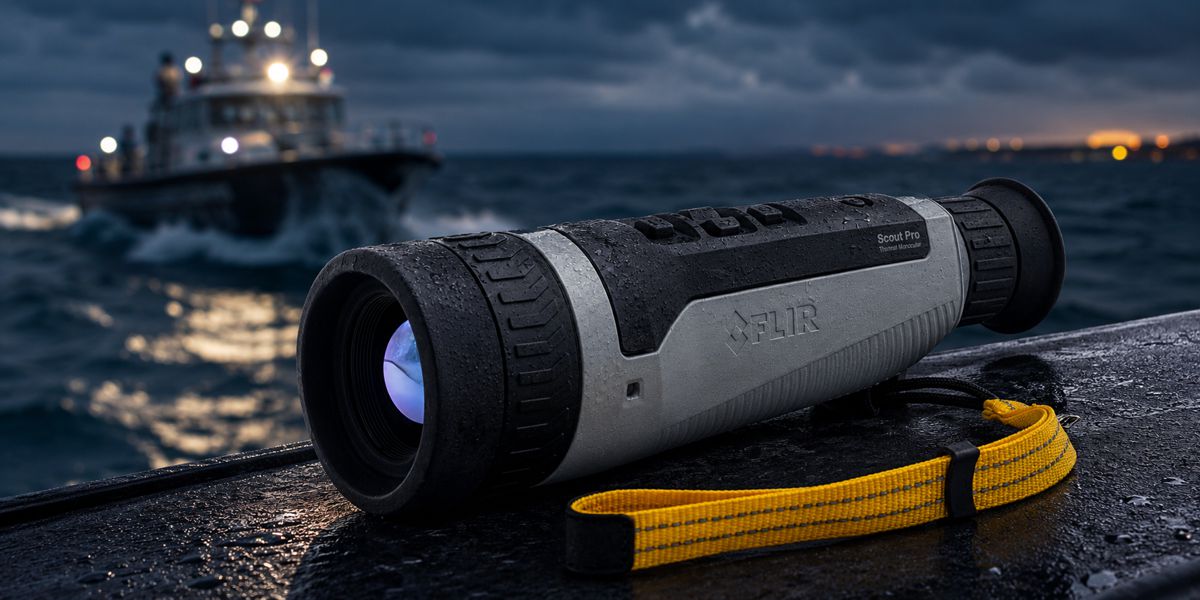
FLIR Marine, part of Teledyne Technologies, is now extending that capability with the introduction of Ocean Scout Pro II, a handheld thermal imaging monocular developed specifically for long-range observation and professional marine operations. Unlike broad-view recreational thermal devices, the latest system focuses on identifying and confirming distant targets at greater stand-off distances while maintaining rapid deployment and ease of use.
The timing reflects a broader shift taking place across maritime safety, offshore infrastructure protection and emergency response, where portable sensing technologies are increasingly expected to bridge the gap between traditional visual observation and permanently installed surveillance systems.
Briefing Summary
- FLIR Marine has launched Ocean Scout Pro II for professional maritime surveillance and search operations
- New optical architecture prioritises long-distance detection over wide-area scanning
- Human heat signatures can be detected at distances up to 1,000 metres
- Wireless evidence capture and rugged field operation support public safety deployment
- The product reflects wider growth in portable thermal sensing across maritime operations
Thermal Imaging Becomes Operational Infrastructure
Thermal imaging has become one of the more quietly influential technologies shaping modern maritime operations. Once associated largely with defence applications and high-cost vessel installations, advances in sensors, processing and portability have opened the technology to broader professional use.
Today, thermal systems support applications ranging from harbour security and coastal monitoring to offshore energy operations and emergency services. Their value lies in a simple principle: thermal sensors don’t depend on visible light. Instead, they identify temperature differences, allowing people, vessels and obstacles to remain visible even in total darkness.
This shift matters for infrastructure and transport operators because response windows offshore are rarely generous. Detecting an object or person several minutes earlier can alter navigation decisions, reduce fuel use during search patterns and improve outcomes during rescue events.
The original Ocean Scout Pro already demonstrated that trend by pairing a 640 × 480 thermal detector with a wide 32-degree field of view designed for rapid environmental scanning and target acquisition. It offered human detection capability to approximately 500 metres and became positioned around situational awareness and broad-area observation.
Ocean Scout Pro II takes a noticeably different direction.
Designed for Distance Rather Than Coverage
Where many marine thermal devices prioritise wider viewing angles, Ocean Scout Pro II has been engineered around deliberate observation at range.
The device adopts a narrower 18-degree field of view and introduces a 35 mm manual-focus lens configuration intended to sharpen target identification at extended distances. According to FLIR, this enables operators to detect human heat signatures at up to 1,000 metres, effectively doubling the detection range compared with the original Ocean Scout Pro platform. That optical decision changes how the equipment is used.
Wide-angle thermal systems excel at scanning broad areas quickly, making them useful for general navigation and recreational boating. Narrower optics, by contrast, suit missions where confirmation matters more than discovery. Law enforcement vessels tracking distant activity, offshore patrol units monitoring exclusion zones and coordinated rescue teams searching known sectors often benefit more from image clarity at distance than maximum coverage.
Manual focus also returns an element of operator control that automated systems sometimes struggle to deliver in low-contrast maritime conditions.
Building Professional Equipment Around Real Working Conditions
Marine equipment rarely fails because of technical limitations. More often, failure comes from complexity, fatigue or environmental exposure. That appears to have influenced the design philosophy behind Ocean Scout Pro II.
The device retains a compact handheld form factor while introducing glove-friendly five-button controls intended to minimise interaction time. Continuous operation is rated at up to six hours through an integrated battery system and the enclosure carries an IP67 rating for water and dust resistance, aligning with expectations for exposed maritime environments.
Thermal processing remains central to the experience. FLIR’s enhancement technologies are intended to improve separation between foreground heat sources and background clutter, something that becomes particularly valuable over water where temperature gradients can flatten perceived contrast.
For first responders and marine professionals, those details aren’t secondary considerations. Equipment that demands menu navigation, frequent charging or excessive training rarely survives operational adoption.
Michelle Hildyard, General Manager of Teledyne’s FLIR Marine brand, said: “Marine professionals and law enforcement officers need tools that work instantly and reliably when visibility is limited and time matters.”
She added: “Ocean Scout Pro II was developed in close collaboration with public safety and maritime professionals to deliver long-range performance without added complexity, allowing users to stay focused on the situation at hand.”
Search and Rescue Enters a More Connected Era
Search and rescue operations continue to evolve from isolated field activity into connected data environments.
Increasingly, imagery captured during incidents is expected to support reporting, evidence collection, operational review and training. That requirement has driven growing demand for portable equipment that can communicate beyond the operator holding it.
Ocean Scout Pro II incorporates wireless image and video streaming through the FLIR Responder mobile application, enabling captured content to be transferred and retained without introducing additional hardware workflows.
For marine enforcement agencies and emergency services, this capability extends the value of handheld sensors beyond observation alone.
A thermal image captured during vessel interception, offshore inspection or rescue coordination may later contribute to procedural review or legal documentation. As maritime governance becomes increasingly digital, portable sensing devices are becoming data collection tools as much as optical instruments.
The Bigger Picture for Maritime Infrastructure
The launch of Ocean Scout Pro II sits within a wider pattern affecting infrastructure, transport and industrial operations.
Ports are becoming smarter. Offshore assets are becoming more autonomous. Vessel operators are under growing pressure to improve safety outcomes while managing labour shortages and tighter operating margins.
Portable sensing technologies fit neatly into that transition because they offer capability without requiring vessel redesign or major capital investment.
A handheld thermal device won’t replace radar, AIS or fixed camera systems. What it can do is provide immediate verification when operators need confidence before acting.
That distinction becomes increasingly important as infrastructure operators seek practical technologies that enhance resilience without adding unnecessary complexity.
Maritime technology tends to reward incremental improvement over dramatic reinvention. Ocean Scout Pro II appears to follow that tradition, focusing less on introducing unfamiliar concepts and more on extending the usefulness of tools operators already understand.
For professionals working offshore, that’s often where the greatest value is found.
Extending Human Vision Without Adding Complexity
Marine operations still depend heavily on human judgement. Sensors may provide information, but people remain responsible for interpreting what they see and deciding what happens next.
Technologies that strengthen those decisions without creating additional friction are usually the ones that endure.
With Ocean Scout Pro II, FLIR is betting that greater range, improved identification and simplified operation matter more than feature overload. In a sector where visibility can define outcomes and minutes can alter consequences, extending sight lines may prove to be one of the most practical advances available.
Thermal imaging isn’t replacing seamanship or operational experience – it’s simply giving them more time to work with.