Turning Captured Carbon Into Graphite Could Reset the Anode Supply Chain
A laboratory result out of California this summer reads at first like a chemistry footnote, but its consequences run straight into one of the most exposed positions in the entire clean-energy build-out. Researchers at the U.S. Department of Energy’s Lawrence Berkeley National Laboratory, UC Berkeley and Estonia’s National Institute of Chemical Physics and Biophysics have shown a way to convert waste carbon dioxide, drawn from the air or captured from industrial exhaust, into solid graphite.
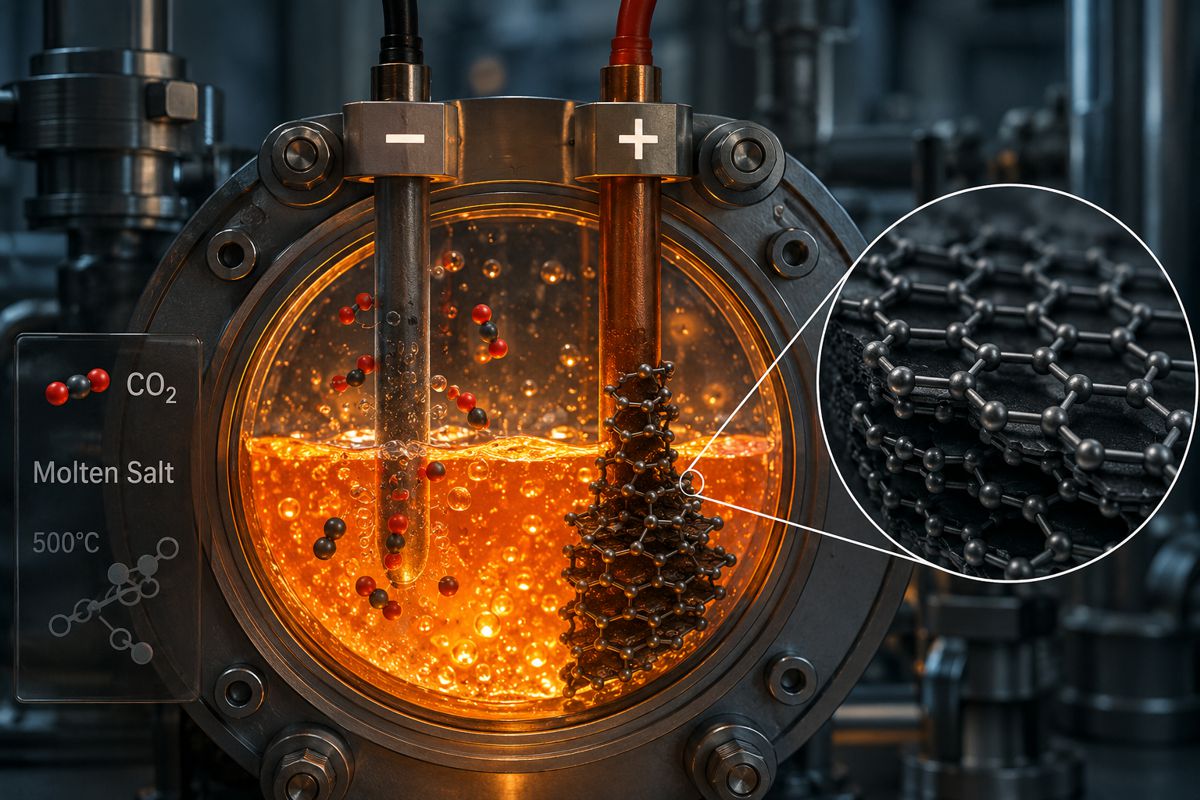
More significantly for anyone tracking where industrial value is concentrating, they watched the conversion happen in real time inside a pool of molten salt heated to 500 degrees Celsius, resolving a decades-old argument about how the reaction actually works. The work was published in Nature Communications and forms part of the Department of Energy’s MINerals for Energy Storage Synthesis programme.
The reason this matters beyond the laboratory is that graphite is the quiet dependency underneath the entire lithium-ion economy, and it is the dependency that has become hardest to secure. It sits in the anode of almost every rechargeable cell, from smartphones and laptops to the battery packs powering an expanding fleet of electric excavators, wheel loaders and industrial machines.
It is also the material where a single country’s grip on production and refining is most complete, and where recent export policy has turned that grip into a live commercial risk. A credible route to manufacturing graphite from a waste gas, rather than mining and refining it, would change the nature of the problem from a geological one into an engineering one, and engineering problems tend to be solvable with capital and time.
Briefing
- Researchers at Berkeley Lab, UC Berkeley and Estonia’s KBFI observed carbon dioxide converting to solid carbon in real time inside molten salt at 500 degrees Celsius, published in Nature Communications under the DOE’s MINES programme.
- The observation revealed an unexpected two-step reaction mechanism and showed the chemistry holds across different electrode and salt combinations, opening a path to tuning the process toward battery-grade graphite.
- China accounts for roughly 80 per cent of mined graphite output and refines well over 90 per cent of the world’s graphite into battery-grade anode material, giving it decisive control over the supply chain.
- The United States is 100 per cent net import reliant for natural graphite, and Washington set a preliminary anti-dumping duty of 93.5 per cent on Chinese anode-grade graphite in July 2025.
- Incumbent synthetic graphite production is energy-intensive and carbon-heavy, requiring around 10 to 15 MWh of electricity per tonne at the graphitisation stage and emitting several tonnes of carbon dioxide per tonne of product.
The Chokepoint That Makes a Laboratory Result Strategic
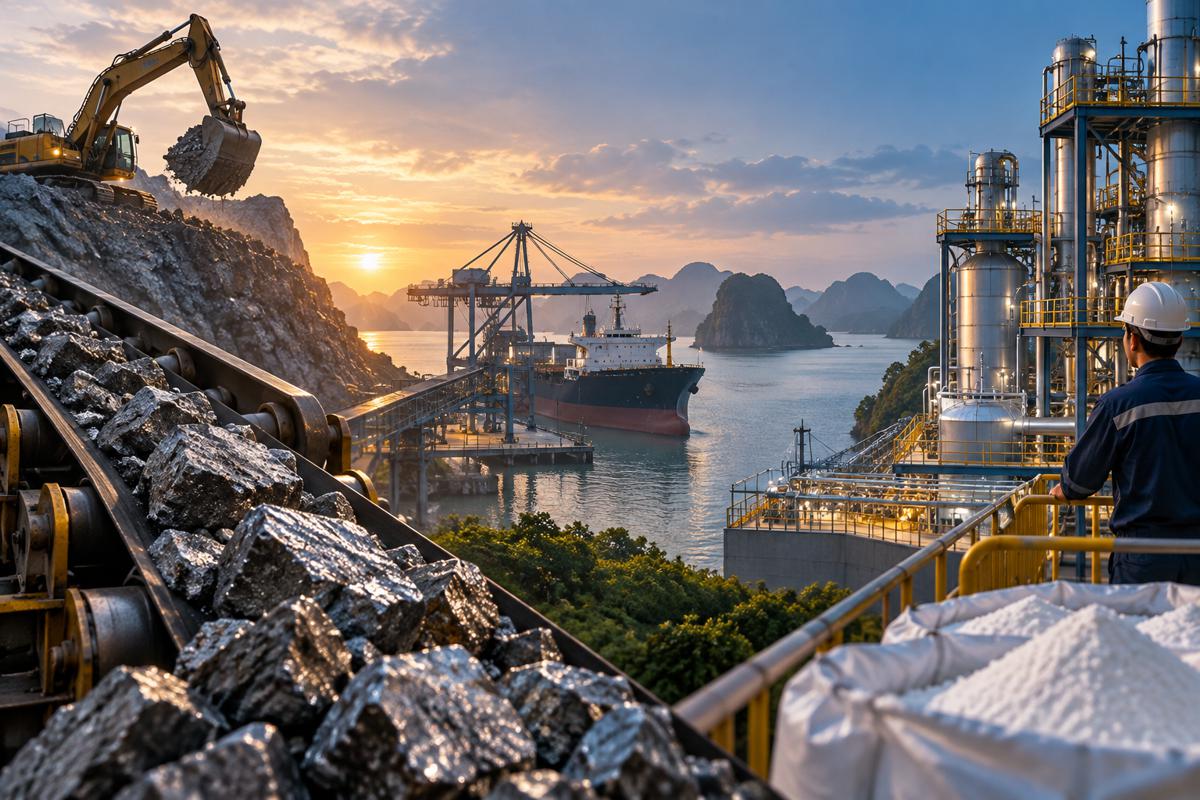
Graphite is not scarce in the ground, but the capacity to turn it into anode material is concentrated to a degree that has no real parallel among battery minerals. China accounted for around 80 per cent of mined graphite output in 2024 and refines the overwhelming majority of the world’s graphite into battery-grade material, with some assessments putting its share of graphitisation capacity above 95 per cent. Raw flake graphite is not battery-ready on its own. It has to be purified, shaped into spheres and coated, and almost all of that downstream processing currently happens in one place. That is the structural weakness a decade of clean-energy planning has failed to close.
The exposure stopped being theoretical in December 2024, when Beijing imposed export licensing on key anode materials, including high-purity synthetic and flake graphite. China widened those controls across the lithium-ion battery supply chain during 2025, before issuing a temporary easing for shipments to the United States in November 2025 that runs only until late 2026. The pattern is unmistakable to any procurement director reading it honestly, because access has been made conditional and the conditions can be reset at short notice.
Washington’s response has been equally pointed, with the Commerce Department setting a preliminary anti-dumping duty of 93.5 per cent on Chinese anode-grade graphite in July 2025, a measure that domestic producers welcomed even as battery makers warned it could add around a thousand dollars to the cost of a pack. The United States, for its part, remains 100 per cent net import reliant for natural graphite, a figure the U.S. Geological Survey has reported without improvement for two consecutive years.
What the Berkeley Lab Work Actually Changes
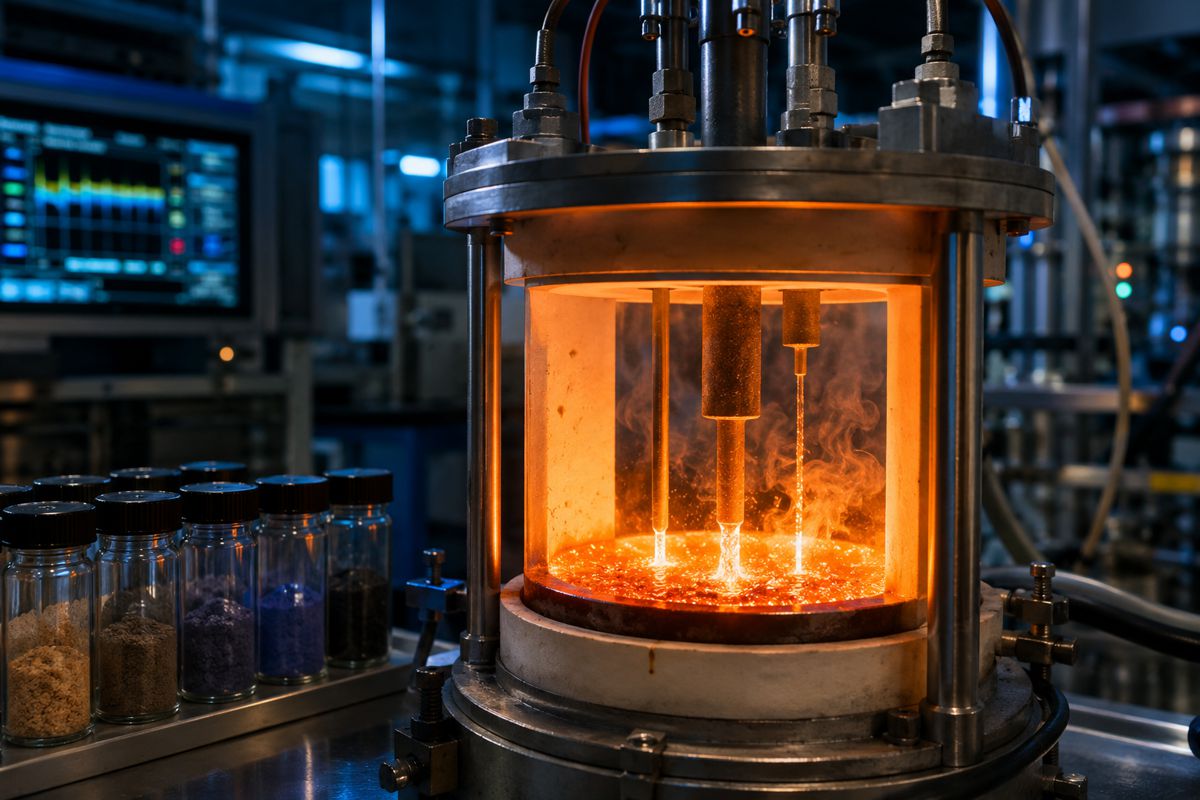
Molten-salt electrolysis is not itself new, and the idea of splitting carbon dioxide into solid carbon has been studied for years. What the team achieved was the ability to see the reaction as it happened, building a custom microscope capable of peering inside a corrosive salt bath at 500 degrees Celsius while current flowed. That single capability matters more than it sounds, because the interior of a molten salt has been almost impossible to observe directly, and process engineers cannot reliably control what they cannot watch. Direct observation turns a black box into something that can be measured, adjusted and optimised.
The observation itself carried a genuine surprise. Rather than converting in one clean step, the carbon dioxide was found to pass through an intermediate before depositing as solid carbon, a two-step pathway that settles a long-running debate about the underlying mechanism. Just as important for anyone thinking about scale, the basic reaction held steady even when the researchers swapped out electrode materials and salt chemistries. Because different materials yield different carbon structures, that consistency implies the process can be tuned toward specific products rather than producing an unpredictable mixture.
As Mike Whittaker, the Berkeley Lab scientist who worked on the project, put it, “This is a major win in a larger effort of synthesizing critical materials and battery materials using molten salts.” Control over the product is precisely what separates a chemistry demonstration from an industrial route to battery-grade graphite.
Why a Carbon-Fed Route Is Commercially Interesting
To understand why a manufactured alternative attracts attention, it helps to look at how the incumbent article is made. Synthetic graphite, the higher-performing option now favoured by many battery makers, is produced from petroleum coke and coal-tar pitch through the Acheson process, in which the material is baked and then held at temperatures approaching 3,000 degrees Celsius for days at a time. Graphitisation alone consumes something in the order of 10 to 15 MWh of electricity per tonne and can account for close to half the finished cost, while life-cycle assessments of Chinese production have put emissions at several tonnes of carbon dioxide for every tonne of graphite. The feedstock is a byproduct of the oil industry, tying the material to fossil supply chains and to a needle-coke stream that is itself tightening.
A route that starts from captured carbon dioxide inverts that logic in two commercially meaningful ways. It replaces a fossil-derived feedstock with a waste stream that many industrial operators are already under pressure to capture, and it sidesteps the graphitisation furnaces where both the energy burden and China’s processing advantage are concentrated.
Whittaker framed the prize in plain terms, noting that “If you could run this process at low temperatures with really cheap salts, you could have it in a lot of places, and you could generate enough graphite that you could feed into battery supply chains.” The conditional is doing real work in that sentence, because cost and temperature are exactly the variables that decide whether a laboratory process ever becomes a factory. Even so, the direction is clear. If graphite can be manufactured near the point of demand from a locally captured gas, the geography of supply becomes a matter of siting plants rather than owning deposits.
Where the Capital Is Already Moving
The market has not waited for a manufactured breakthrough to start hedging its graphite exposure, and that context is what gives the Berkeley Lab result its commercial resonance. Syrah Resources has restarted its Balama operation in Mozambique and is building spherical graphite capacity in the United States, one of only a handful of companies attempting to establish downstream processing outside China. Graphite One has moved to knit together a domestic chain through the Minerals for National Automotive Competitiveness collaboration, including an agreement with electric-vehicle maker Lucid, while the Department of Energy has directed billions of dollars in loans and grants toward domestic battery and battery-materials projects. Each of these is, in effect, a bet that supply security now carries a premium worth paying for.
Against that backdrop, a manufactured graphite route would not arrive into an empty field but into a market already restructuring around resilience. It would compete less on headline cost, where Chinese oversupply has pushed prices to multi-year lows, and more on the attributes that policy and procurement are increasingly willing to reward, namely provenance, carbon intensity and independence from a single processing hub.
That is a favourable environment for a low-carbon, locally sited production method to establish itself, even before it matches incumbent economics. The companies and public agencies putting money into non-Chinese supply are, whether they intend it or not, building the commercial runway that an approach like this would eventually need.
The Off-Highway Dimension That Rarely Gets Named
Coverage of graphite tends to default to passenger electric vehicles, but the exposure runs directly through construction and infrastructure. Electric excavators, wheel loaders, telehandlers and compaction machines from the major off-highway manufacturers rely on the same lithium-ion chemistry, and therefore on the same graphite anode, as any car. A single electric passenger vehicle contains somewhere between 50 and 100 kilograms of graphite, and heavier off-highway machines with larger packs carry correspondingly more. The industrial power equipment referenced in the original research is not a side note for this readership. It is the category many Highways.Today readers specify, finance and operate.
That shared dependency means fleet owners, plant hirers and infrastructure clients sit on the same supply chain as the automotive giants, but usually with less purchasing leverage and thinner visibility into where their cells originate. Grid-scale energy storage, which underpins the charging infrastructure that electric plant will depend on, draws on the same anode material again, compounding the exposure across the whole electrification programme.
A manufacturing route that could eventually localise graphite production would therefore reach beyond the battery makers to the equipment ecosystem and the projects it serves. For infrastructure owners planning decade-long electrification strategies, the resilience of the graphite supply chain is not an abstract commodity question but a direct input to fleet availability and lifecycle cost.
What Has to Be True for This to Scale
Confidence about direction should not be mistaken for a finished product, and the honest assessment is that several hard problems stand between the current result and an industrial plant. The researchers themselves identify the next stage as finding the optimal combinations of salts, electrode materials, temperatures and voltages, then scaling the approach to produce industrially useful quantities rather than laboratory samples.
Battery-grade graphite must meet exacting purity and structural specifications, and qualifying a new material into cell production lines is a slow, conservative process measured in years. The electricity that drives the electrolysis also has to come from somewhere, and the environmental case only holds if that power is low-carbon, otherwise the process simply relocates the emissions rather than removing them.
None of this diminishes the significance of what has been demonstrated, but it does define what industry leaders should watch for next. The signals that would indicate real momentum are demonstrations at pilot scale, evidence that the process runs at lower temperatures with inexpensive salts as Whittaker suggested, and the first qualification data showing the output meets anode specification.
Investors tracking the space would do well to distinguish between companies pursuing tunable, mechanism-led production and those simply chasing the graphite headline. The value here is likely to accrue to whoever controls the process intellectual property and the ability to hit battery grade consistently, rather than to whoever moves first or loudest.
Reading the Signal Correctly
The most useful way to read the Berkeley Lab result is as a marker of where strategic value in the battery supply chain is migrating. For a generation, control of graphite has meant control of deposits and, more decisively, control of refining capacity. A manufactured route fed by captured carbon would begin to shift that advantage from geology toward process engineering, from owning the right rocks toward owning the right method. That is a structural change in how a critical mineral is secured, and it aligns neatly with the direction policy in Washington, Brussels and allied capitals has already taken.
For construction and infrastructure leaders, the practical lesson is to treat graphite supply as a board-level input to electrification planning rather than a procurement detail left to suppliers. The material sits at the base of the electric plant, the charging network and the storage systems that decarbonisation strategies depend upon, and its supply remains concentrated in ways that policy can disrupt overnight.
Approaches that could eventually manufacture graphite from waste carbon, close to the point of use and with a lower carbon footprint, deserve to be watched not as speculative science but as early indicators of where a more resilient supply chain might be built. The chemistry has been proven at bench scale. The commercial contest over who industrialises it is only beginning.
Key Industry Questions
- Why is graphite considered the most exposed material in the battery supply chain? Graphite forms the anode in almost every lithium-ion cell and is the largest single component by mass, yet its supply is more concentrated than any other battery mineral. China accounts for roughly 80 per cent of mined output and refines well over 90 per cent of the world’s graphite into battery-grade material, controlling the purification, spheronisation and coating steps that raw ore requires. The United States is 100 per cent net import reliant for natural graphite. That combination of high demand, essential function and single-source processing makes graphite the tightest link in the chain, and the one most vulnerable to export policy, tariffs and geopolitical friction.
- What did the Berkeley Lab research actually demonstrate? The team converted carbon dioxide into solid carbon using molten-salt electrolysis and, for the first time, observed the reaction in real time inside a corrosive salt bath at 500 degrees Celsius. They found the conversion proceeds through an unexpected two-step mechanism, settling a long-standing scientific debate, and confirmed that the basic reaction holds across different electrode and salt combinations. Because varied materials produce different carbon structures, that consistency suggests the process can be tuned toward specific products, with battery-grade graphite as the eventual goal. The work is a mechanistic and observational advance rather than a commercial production system.
- Could this replace graphite mining and refining? Not yet, and not without substantial scale-up. The research establishes a proven route and a way to control the reaction, but producing industrially useful quantities of battery-grade material remains the next challenge. Any manufactured graphite must meet strict purity and structural specifications and pass slow qualification into cell production lines. The environmental and cost case also depends on running the process at low temperatures with cheap salts and low-carbon electricity. The realistic near-term outcome is a complementary supply source that diversifies the chain rather than an immediate replacement for established mining and processing.
- How does synthetic graphite production compare on cost and emissions? Conventional synthetic graphite is made from petroleum coke and coal-tar pitch through the Acheson process, which holds material at temperatures near 3,000 degrees Celsius for days. Graphitisation alone consumes roughly 10 to 15 MWh of electricity per tonne and can represent close to half the finished cost, while life-cycle studies of Chinese production have reported emissions of several tonnes of carbon dioxide per tonne of graphite. The feedstock is tied to oil-refining byproducts. A route starting from captured carbon dioxide would replace that fossil feedstock with a waste stream and could bypass the most energy-intensive furnace step.
- What does this mean for electric construction equipment? Electric excavators, wheel loaders and other off-highway machines use the same lithium-ion chemistry and graphite anodes as passenger vehicles, so they share the same supply-chain exposure. Larger machine packs contain correspondingly more graphite, and the charging infrastructure and grid-scale storage that support electric plant draw on the same material again. Fleet owners and infrastructure clients therefore carry graphite risk directly, often with less purchasing leverage than automotive manufacturers. A localised manufacturing route would improve resilience across the whole electrification programme, from machines to charging networks, and feed directly into fleet availability and lifecycle cost planning.
- Why do China’s export controls matter so much to buyers? Because access to processed anode material has been made conditional rather than guaranteed. Beijing imposed export licensing on key anode materials in December 2024, widened controls across the battery supply chain during 2025, then issued a temporary easing for United States shipments valid only until late 2026. Even where shipments continue, the licensing regime signals that supply can be restricted or re-priced at short notice. For manufacturers and fleet operators planning multi-year electrification, that uncertainty raises the value of any supply that sits outside the single dominant processing hub, which is exactly the gap a manufactured route aims to address.
- Where is investment in non-Chinese graphite currently flowing? Capital is moving toward mining outside China and, more importantly, toward downstream processing capacity. Syrah Resources has restarted its Balama operation and is developing spherical graphite capacity in the United States, while Graphite One has pursued a domestic chain through the Minerals for National Automotive Competitiveness collaboration, including an arrangement with Lucid. The Department of Energy has directed billions of dollars in loans and grants toward domestic battery and battery-materials projects. These commitments are effectively bets that supply security now carries a premium, and they build the commercial environment a manufactured route would eventually enter.
- What should infrastructure and fleet leaders do with this information now? Treat graphite supply as a strategic input to electrification planning rather than a procurement detail. That means understanding where the cells in specified equipment originate, factoring supply-chain concentration into fleet transition timelines, and monitoring the resilience measures suppliers are taking. It also means watching emerging production routes for credible pilot-scale evidence rather than reacting to headlines. The immediate action is not to change equipment decisions, but to build graphite exposure into risk assessments and decade-long electrification strategies, so that fleet availability is not quietly hostage to a single processing geography.
Strategic Takeaways
- Graphite is the battery supply chain’s most concentrated dependency, and any credible route to manufacturing it from waste carbon reframes the problem from geology to engineering, which capital and time can address.
- Strategic value in graphite is beginning to migrate from owning deposits and refining capacity toward controlling the process intellectual property and the ability to hit battery grade consistently.
- Construction and infrastructure carry direct graphite exposure through electric plant, charging networks and grid storage, making supply resilience a board-level input to electrification planning rather than a procurement footnote.
- Incumbent synthetic graphite is energy-intensive, carbon-heavy and tied to fossil feedstocks, giving a low-carbon, locally sited alternative a favourable policy and procurement environment even before it matches incumbent cost.
- The decisive signals to watch are pilot-scale demonstrations, evidence of low-temperature operation with cheap salts, and first qualification data proving the output meets anode specification.