Tackling the Filter-Loading Problem on India’s Trains
Keeping fine dust out of a railway carriage is relatively straightforward when the air outside is reasonably clean. Maintaining the same filtration performance when a train is repeatedly drawing heavily contaminated air through its HVAC system is a rather different engineering problem.
Researchers at the Korea Institute of Machinery and Materials (KIMM) are developing a compact electrostatic air purification module specifically around that problem, with Indian passenger trains intended to provide the proving ground.
The system is being developed by researchers including Principal Researchers Dr Sang Bok Kim and Dr Inyong Park and Senior Researcher Dr Younghun Kim from KIMM’s Department of Urban Environment Research, working with THN Co., Ltd., a KIMM Family Company. It forms part of KIMM’s Air Five air purification programme.
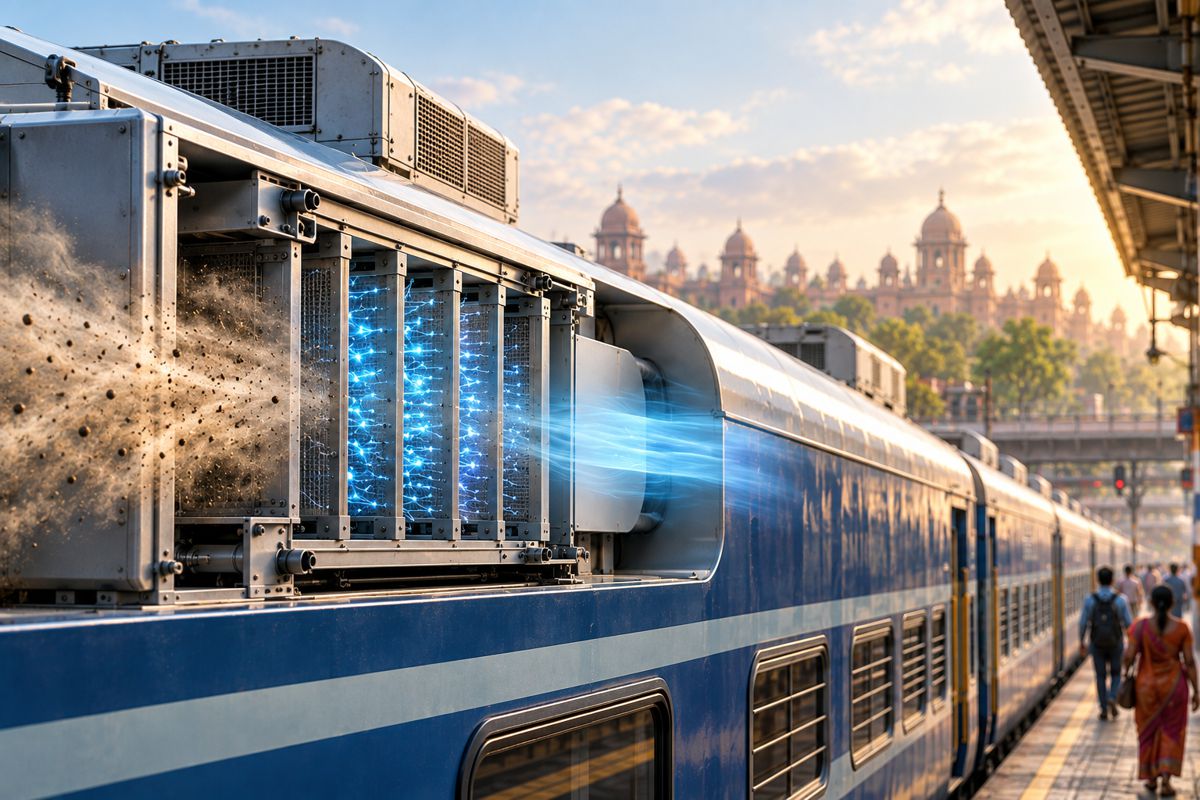
Rather than forcing contaminated air through progressively loaded filter media, the system electrically charges airborne particles before collecting them on oppositely charged plates. KIMM’s objective is to achieve particulate removal performance equivalent to MERV 15 while producing a module compact enough to be fitted into existing train HVAC systems without structural alterations.
Railway HVAC equipment has limited space, airflow requirements cannot simply be sacrificed in pursuit of better filtration, and replacing complete systems across an established fleet would make adoption considerably more difficult. KIMM is therefore tackling filtration performance and retrofitability as parts of the same engineering problem.
Briefing
- KIMM is developing a compact electrostatic precipitator for installation in existing Indian train HVAC systems.
- The target is fine-particle removal performance equivalent to MERV 15.
- Electrostatic collection is intended to avoid the rapid clogging and increasing airflow resistance associated with conventional filter media in dusty environments.
- Field trials in India will examine particulate removal, durability, energy efficiency and long-term stability.
- The research programme runs from May 2026 to December 2027 and is supported through South Korea’s Industry Demand-Based 1% MVP Project.
The Filter-Loading Problem
Conventional HVAC filters work by passing air through fibrous media that captures suspended particles. As material accumulates, resistance to airflow increases, potentially reducing airflow and eventually requiring the filter to be cleaned or replaced. The problem becomes more pronounced when incoming air carries a high particulate load, particularly on a railway vehicle where filtration has to operate within the capacity and physical constraints of existing ventilation and air-conditioning equipment.
KIMM’s proposed electrostatic precipitator takes a different route. Particles passing through the unit receive an electrical charge and are subsequently attracted to collecting surfaces carrying the opposite charge. Because air does not have to pass through densely packed filtration media to achieve the principal cleaning effect, the researchers expect the system to retain a more open airflow path under high dust concentrations.
Electrostatic precipitation itself is well established in air cleaning and industrial emissions control. KIMM instead has to package the process into railway HVAC equipment, maintain sufficient particle collection efficiency, control its electrical and energy requirements and prove that performance survives prolonged exposure to the environment encountered by Indian trains.
A MERV 15 Target
KIMM is aiming for fine-dust reduction equivalent to MERV 15. MERV, or Minimum Efficiency Reporting Value, describes particle-removal performance under the ASHRAE 52.2 testing system. At MERV 15, the specified minimum composite average efficiency is 85% for particles between 0.3 and 1.0 micrometres, 90% for particles from 1.0 to 3.0 micrometres and 95% for particles between 3.0 and 10.0 micrometres.
Simply adding a higher-rated conventional filter is not necessarily an elegant answer. Filtration efficiency has to be considered alongside airflow resistance, available fan capacity, physical space and maintenance requirements. A railway HVAC installation still has to move enough conditioned air through the carriage while accommodating equipment within a vehicle envelope that may have been designed long before upgraded filtration was contemplated.
KIMM is pursuing retrofitability as part of the design rather than treating it as an installation problem to be solved afterwards. The module is intended to fit existing HVAC systems without modification to the train structure.
Indian Railways as a Test Environment
The project originated with a request from an Indian railway company seeking better air purification for passenger cabins. KIMM says the principal requirement is to remove fine particles entering from outside while maintaining acceptable air quality within the carriage.
India also provides demanding operating conditions in which to test the technology. Dust loading, local climate, long operating hours and variations in environmental conditions can expose weaknesses that are less apparent during controlled laboratory testing. KIMM intends to examine removal efficiency, durability and energy consumption on trains operating locally, while monitoring whether performance remains stable over extended periods.
There is already a relevant technical precedent within Indian railway engineering. Specifications published by the Research Designs and Standards Organisation for railway air-conditioning equipment include requirements covering filter efficiency, dust-holding capacity and pressure drop, together with clogged-filter indication.
The specification also provides an option for manufacturers to explore electrostatic filtration in place of mixed or return-air filtration with activated carbon, calling for average minimum filtration efficiency of 95% for particles between 0.3 and 2.5 micrometres. Electrostatic filtration is therefore already contemplated within the railway HVAC environment in which KIMM intends to demonstrate its system, although that does not establish approval or compliance for KIMM’s particular implementation.
Testing Beyond Particle Removal
The Indian field programme will examine durability and energy efficiency alongside particulate removal, looking particularly for problems associated with sustained high dust concentrations and local climatic and environmental conditions. Results from those trials will be used to adapt the technology to Indian railway requirements.
A filtration technology that performs well when clean but deteriorates rapidly under contamination merely moves the maintenance problem elsewhere. Electrostatic collection avoids the progressive physical blockage of conventional filter media, but it is not maintenance-free. Collected particulate still has to be removed from collection surfaces, while the complete system has to remain reliable under vibration, temperature changes and repeated railway operation.
Those operational questions will ultimately determine whether the technology can move beyond laboratory efficiency figures into routine railway service.
Adding Biological Air Treatment
KIMM is also planning a second development path with Chonnam National University, integrating a system intended to inactivate airborne infectious agents. The aim is eventually to combine particulate removal and biological air treatment within a broader indoor air-quality system for public transport.
That work remains at the development stage and is separate from the project’s particulate-filtration targets until performance has been demonstrated. If successful, combining functions inside a compact HVAC module could broaden the potential application to other high-occupancy environments where particulate control, ventilation and management of airborne contaminants have to be accommodated within limited space.
Beyond the Railway Carriage
KIMM is already looking beyond trains. Airports, hospitals, government buildings and other public facilities are among the applications being considered, with pilot deployments being pursued at Indian government agencies, public institutions and major hospitals.
The organisation also sees India as a potential starting point for expansion into other Asian markets, including Thailand and Vietnam, where high particulate concentrations can create similar demands on ventilation equipment. That commercial path will depend heavily on what happens during the Indian demonstrations. Successful particle removal in controlled testing establishes the principle; operating for long periods in railway service without unacceptable maintenance, airflow or energy penalties establishes a product.
Dr Sang Bok Kim said: “This research is significant in that it will directly apply Korean-developed air purification technology to trains operating in India, which suffer from severe fine-dust pollution, and verify its performance and reliability under real-world conditions. We plan to successfully complete the field demonstrations and expand the technology’s application across a wide range of HVAC markets, including not only railways but also hospitals, airports, and public facilities, thereby contributing to the overseas expansion of Korean air purification technologies.”
The research is supported by the Industry Demand-Based 1% MVP Project of South Korea’s Ministry of Trade, Industry and Energy and the Korea Institute for Advancement of Technology, with the programme scheduled to run from May 2026 until December 2027.
For the moment, the engineering challenge is more interesting than the prospect of another air purifier. High-efficiency filtration is readily available. Making it compact, retrofit-friendly and capable of maintaining airflow and particle-removal performance when the incoming air carries a punishing dust load is a much harder test.
If it survives India’s railways, there should be no shortage of other HVAC systems in which to try it.
Key Industry Questions
- How does KIMM’s railway air purifier work? It uses electrostatic precipitation. Fine particles are electrically charged as they pass through the unit and are subsequently captured on oppositely charged collection surfaces.
- Why use electrostatic precipitation instead of a conventional filter? Conventional filter media accumulate dust, increasing resistance to airflow as they load. Electrostatic collection can maintain a more open airflow path, potentially making it useful where particulate concentrations are high.
- What filtration performance is KIMM targeting? The researchers are targeting fine-dust reduction equivalent to MERV 15.
- Can the system be retrofitted to existing trains? That is one of the project’s principal design objectives. KIMM says the compact module is intended for installation in existing train HVAC systems without structural modification.
- Why is the system being tested in India? The project originated from a request by an Indian railway company, while India’s high particulate concentrations provide demanding conditions in which to test filtration performance and durability.
- Does Indian railway engineering already permit electrostatic filtration? An RDSO specification for railway air-conditioning equipment includes electrostatic filtration as an option and sets filtration-efficiency requirements for such equipment.
- What will the field trials measure? KIMM plans to evaluate particulate removal, durability, energy efficiency and long-term stability under Indian operating and environmental conditions.
- Could the technology be used outside railways? Potential applications identified by KIMM include airports, hospitals, government buildings and other public facilities.
- When is the research programme due to finish? The current programme runs from May 2026 to December 2027.
Strategic Takeaways
- Retrofit compatibility could be as important commercially as headline filtration efficiency because it reduces the need to redesign existing railway HVAC installations.
- High particulate loading makes long-term airflow and maintenance performance central to the technology’s value proposition.
- India’s railway environment provides a demanding field test that should reveal limitations difficult to reproduce through short laboratory trials.
- Existing Indian railway specifications already contemplate electrostatic filtration, reducing one potential technical barrier to its introduction.
- Successful railway trials could provide a reference application for public-building HVAC markets facing similar particulate problems.