The Global Language of the Hard Hat
Ten years ago, Highways England attempted to solve a surprisingly persistent problem on British construction sites. Contractors were using different colours of safety helmet to identify different people, which meant a hard hat that signified one role on one project could mean something else on the next. The solution was a common colour scheme intended to make the workforce easier to identify and the rules easier to understand.
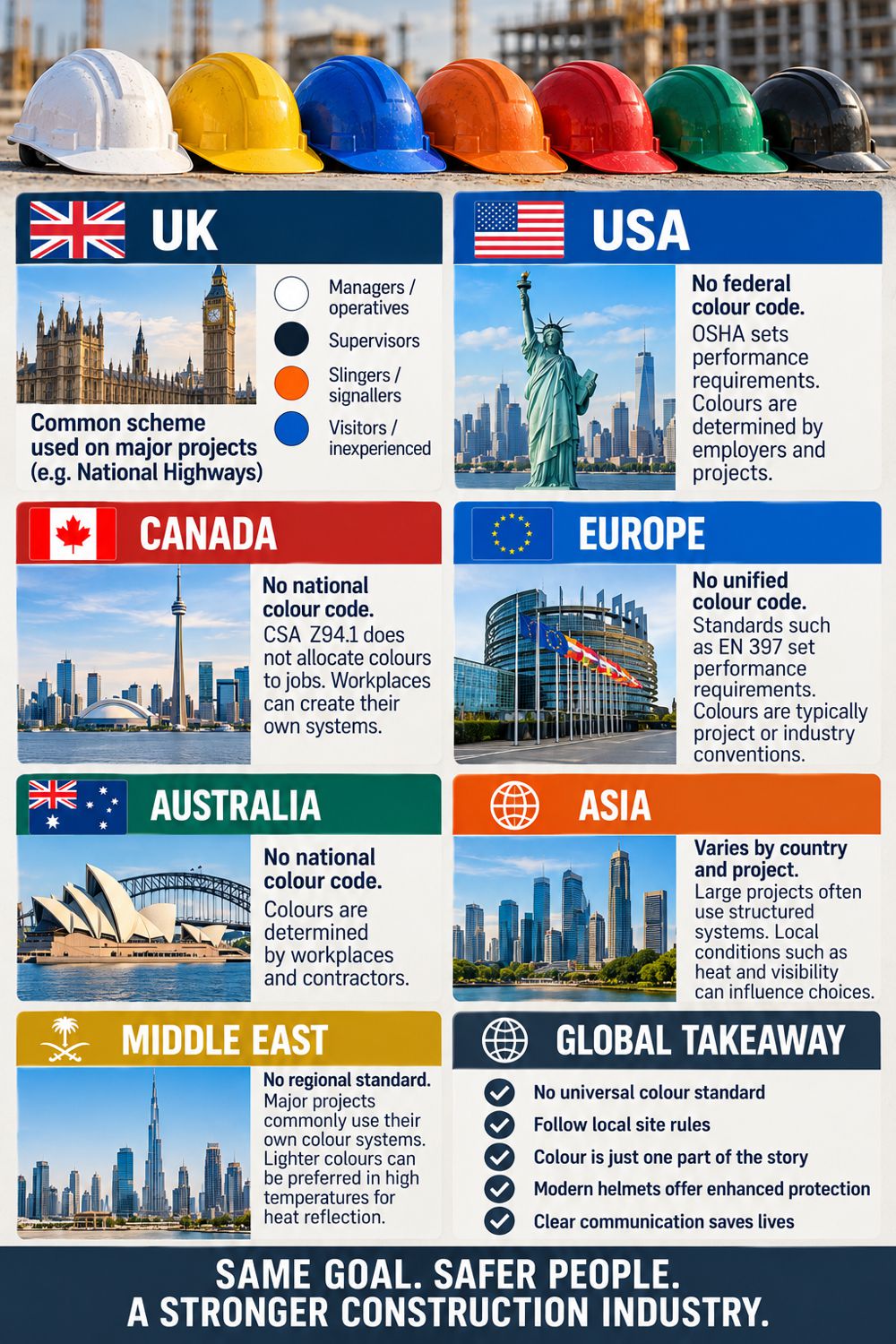
White helmets were assigned to site managers, competent operatives and vehicle marshals, black to supervisors, orange to slingers and signallers, and blue to everyone else, including visitors and inexperienced workers. The arrangement followed the Build UK approach and was introduced across Highways England construction and maintenance activities from the beginning of 2017. Highways England has since become National Highways, but the problem it was trying to solve remains familiar.
Hard hats are so commonplace that their colours can appear almost self-explanatory. White belongs to management, yellow to workers, green to safety and blue to technical trades, or so countless charts on the internet would suggest. Take that chart across an international border, however, and its authority can disappear remarkably quickly.
There is no universal global language of hard-hat colours. In many countries there is not even a nationally mandated one. Colours can be prescribed by a major client, adopted through industry convention, devised by a contractor or changed from one project to another. Meanwhile, industrial head protection itself has continued to develop, with different helmet designs, retention systems, impact requirements, integrated accessories and visibility provisions changing what companies need to consider when specifying protection.
The colour is still useful. It is simply only one part of the story.
Briefing
- Hard-hat colours are not governed by a universal international system, despite apparently authoritative colour charts circulating online.
- Highways England introduced a common four-colour system in 2017 after identifying inconsistent helmet requirements among its contractors.
- US and Canadian safety requirements concentrate primarily on helmet performance and workplace hazards rather than prescribing occupational colours.
- Modern industrial helmets are increasingly selected according to impact, electrical, retention, visibility and working-at-height requirements rather than colour alone.
- BS EN 397 was substantially updated in 2025 as the technical standards governing industrial helmets continue to evolve.
Britain Tries to Standardise the Colours
Highways England’s 2016 decision was less about the protective performance of the helmet than communication. Its Raising the Bar guidance recorded that contractors were specifying different helmet requirements because there was no agreed industry standard. A common system could allow somebody’s role and level of responsibility to be recognised more readily, while reducing the need for companies to maintain stocks of different helmets for different contracts.
The approach broadly followed the Build UK colour standard and deliberately reduced the number of colours in circulation. Orange was particularly useful around lifting operations because it identified slingers and signallers, while black distinguished supervisors. Blue became the general category covering workers who did not fall within the white, black or orange groups.
There were exceptions. Network Rail requirements had to be accommodated where work took place on or near the railway, demonstrating even within Britain how difficult it could be to create one visual language across adjoining infrastructure systems.
The underlying principle nevertheless made sense. On a large construction site, visual identification can be considerably quicker than checking a badge, asking somebody’s job or trying to recognise people in identical high-visibility clothing. A crane operator, plant driver or newly arrived contractor may need to locate the person responsible for an operation quickly, and colour can provide that information from across the site, provided everyone understands the same code.
That becomes particularly useful on multinational projects. A simple visual identifier does not require a worker to read a job title or necessarily share a language with the person being identified. The simplicity that gives colour coding its value also creates its weakness: its meaning has to be learnt locally.
A Colour Changes Meaning at the Border
Construction has internationalised considerably while its helmet conventions remain stubbornly local. A project can involve a European contractor, an American consultant, an Asian equipment supplier and workers recruited from several countries. Engineers, operators and supervisors routinely move between projects and jurisdictions, making the assumption that a familiar helmet colour carries a familiar meaning increasingly unreliable.
The United States provides a useful contrast with Britain’s attempt at occupational colour coding. The Occupational Safety and Health Administration requires protective helmets where workers are exposed to potential head injury and specifies recognised performance requirements for compliant protection. It does not establish a federal colour scheme identifying construction occupations.
An American contractor can therefore use helmet colours as part of its own site management system, and many do. White, yellow, blue, green and other colours consequently acquire familiar associations, but those conventions should not be confused with a statutory national code.
Canada makes the distinction particularly clear. The Canadian Centre for Occupational Health and Safety states that CSA Z94.1 does not indicate different colours for different jobs. Workplaces can establish their own systems for departments, occupations or experience levels, while the underlying safety requirements concentrate on selecting head protection appropriate to the hazards.
That separates standards from conventions. A convention may be widely recognised without being mandatory. A company’s internal colour system may work perfectly well across its own projects without meaning anything outside them, while a major infrastructure client can impose a consistent scheme throughout its supply chain without creating a national standard.
Internet searches tend to blur those distinctions. Neatly presented graphics assign yellow to labourers, blue to electricians, green to safety personnel, red to firefighters and white to managers, sometimes presenting the arrangement as though construction workers from Manchester to Mumbai follow the same rules. They do not, and the induction at the project gate remains considerably more authoritative than a global colour chart found online.
Different Sites, Different Priorities
The further the comparison travels, the more difficult a simple international chart becomes.
Australia and New Zealand have established standards governing industrial safety helmets, while colours are commonly determined through workplace and contractor practice. Familiar conventions can still develop, with colours used to distinguish supervisors, workers, trades, safety personnel or visitors, but those meanings cannot automatically be transferred from one project to another.
The same basic distinction appears across many major construction markets in Asia and the Middle East. Large infrastructure, energy and industrial projects can operate highly structured identification systems, particularly where multinational workforces and extensive subcontracting make immediate recognition useful. The colours chosen by one owner or principal contractor do not necessarily carry across to the next.
Local operating conditions can also change the reason for selecting a colour. Hong Kong’s Labour Department places considerable emphasis on the physical performance, correct selection and maintenance of safety helmets. Its guidance describes the helmet as a system comprising the shell, harness and chin strap, with impact energy managed through the interaction of those components.
Visibility and climate also enter the calculation. A helmet used beside moving plant, inside a tunnel or on a road project at night presents different requirements from one worn in a controlled indoor environment. In strong sunshine, lighter colours can be advantageous for heat reflection, while conspicuous or retroreflective elements can improve the visibility of workers in poorly illuminated environments.
Colour can therefore perform two quite different jobs: identifying who somebody is and helping ensure that somebody can be seen. Those purposes do not necessarily demand the same colour.
From Hard Hat to Safety Helmet
The other change since 2016 is happening underneath the colour.
For generations, the familiar image of construction head protection has been the conventional hard hat: a rigid shell, internal suspension and brim, commonly worn without a chin strap. It remains widely used and, where correctly specified for the hazard and compliant with the applicable standard, provides legitimate industrial head protection.
The range of designs seen on modern sites has nevertheless expanded. Helmets offering greater retention, different impact characteristics and more extensive head coverage have become increasingly visible, particularly where workers operate at height or where keeping the helmet correctly positioned during an incident is important. Chin straps, revised suspension arrangements, integrated eye protection, hearing protection and accessory mounting systems can all form part of the specification.
This development is sometimes reduced to the idea that the traditional hard hat is being replaced by a newer and inherently safer type of helmet. The technical position is more nuanced. Protective headwear is selected against defined hazards and performance requirements, and different standards and helmet classifications test different characteristics. Appearance alone says relatively little about the protection being provided.
North American standards illustrate the distinction particularly clearly. Protective helmets can be classified according to the types of impact against which they are tested as well as their electrical characteristics. Type I helmets are intended primarily to reduce forces resulting from an impact to the top of the head, while Type II helmets incorporate additional requirements addressing impacts from other directions.
That classification says considerably more about what happens when something strikes the helmet than its colour ever could.
The Standards Keep Moving
Europe has also been updating the technical framework. BS EN 397:2025, the current British adoption of the European standard for industrial protective helmets, was published in September 2025 and specifies requirements covering design, performance, testing and markings for helmets intended for general industrial use.
The 2025 revision reflects a much more detailed approach to helmet performance than the familiar appearance of the equipment might suggest. The standard addresses impact and penetration performance alongside requirements covering retention systems and markings, with additional performance provisions available for particular conditions and applications. Enhanced visibility can also form part of the specification through fluorescent shell colours and retroreflective material.
A helmet has to manage impact energy while remaining wearable for long shifts. Depending on the application and standard, it may also need to deal with penetration, electrical hazards, temperature, lateral forces or the risk of being displaced during an incident. Accessories must be compatible with the protective system rather than simply provide convenient additions to the shell.
Inspection and replacement are equally important. Canadian guidance, for example, recommends inspection of the shell, liner and suspension before use and replacement where cracking, dents, cuts, deterioration or other damage is identified. A helmet subjected to an impact may require replacement even when obvious external damage is absent.
The familiar coloured shell is therefore only the visible part of a small piece of engineered safety equipment.
Colour Still Has a Job
None of this makes colour coding obsolete. Large projects need simple methods of communicating information, particularly on sites where workers may speak different first languages, visibility can be poor and people routinely work around moving vehicles and heavy machinery. Being able to recognise a supervisor, lifting specialist, marshal, first aider or inexperienced worker at a glance can remain operationally useful.
The weakness appears when convention is mistaken for certainty. A worker arriving from another country may bring an entirely reasonable understanding of what a particular helmet colour means, only to discover that the new project’s system is different. The same can apply to subcontractors moving between clients within one country. Effective colour coding depends less upon choosing supposedly universal colours than making the project’s particular system unambiguous during induction and applying it consistently.
There is also a limit to how much information can sensibly be encoded in the shell. Construction sites already use coloured high-visibility clothing, badges, stickers, competency cards, access-control systems and other identifiers. Adding ever more categories of helmet colour can eventually make a simple system harder rather than easier to interpret.
Digital worker credentials, access systems, location technology and electronic competency records can hold information that a coloured shell never could. A helmet might identify someone as a supervisor, but it cannot establish whether that person holds the current competency required for a particular operation. Conversely, a digital credential cannot necessarily help a machine operator recognise the correct person standing 15 metres away.
The two approaches can coexist. Colour remains immediate, visible and independent of batteries or network connections, while digital systems can carry the detailed information that colour cannot.
Ten Years On
The Highways England scheme introduced in 2017 addressed a practical problem. Different contractors were using different systems, so a common client standard made construction sites easier to interpret. Ten years later, that problem becomes more interesting when viewed internationally.
Construction operates through increasingly global supply chains, multinational joint ventures and mobile workforces, yet one of its most visible pieces of safety equipment still speaks a collection of local dialects. The helmet may comply with recognised technical standards while the meaning of its colour changes at the project gate.
Perhaps that does not require a universal solution. Projects differ, hazards differ and organisations have legitimate reasons for identifying people in different ways. A worldwide colour standard would only be useful if workers, contractors and clients actually adopted and understood it. The more durable common language lies in impact performance, retention, electrical protection, visibility, certification and selecting the correct equipment for the hazard.
Ten years ago, the question was what colour somebody’s hard hat should be. The better question today is what the helmet is expected to do when it is actually needed.

Key Industry Questions
- Is there an international standard for hard-hat colours? No. International and national standards generally concentrate on the protective performance of helmets. Colour coding is commonly established by clients, contractors, workplaces or industry conventions.
- What do hard-hat colours mean in the UK? There is no single colour code covering every British workplace. Build UK developed a standardised construction scheme, subsequently adopted by Highways England, using white, black, orange and blue for defined groups. Individual sectors and sites can have different requirements.
- Does OSHA specify hard-hat colours in the United States? No. OSHA’s head-protection rules concern when protection is required and the performance criteria it must satisfy. They do not establish a federal occupational colour code for construction helmets.
- Does Canada have a national hard-hat colour code? No. The Canadian Centre for Occupational Health and Safety states that CSA Z94.1 does not specify different colours for different jobs. Individual workplaces may create their own colour systems.
- Why are chin straps becoming more common on construction helmets? A suitable retention system can help keep protective headwear in position during certain incidents and working conditions, particularly where there is a risk of the helmet becoming dislodged. The appropriate helmet and retention system depends on the hazard and applicable standard.
- Are modern safety helmets safer than traditional hard hats? Not simply because of their appearance. Protective headwear should be assessed according to the hazards present and the performance requirements against which it has been designed and tested.
- What is BS EN 397:2025? It is the current British standard for industrial protective helmets, specifying design, performance, testing and marking requirements for helmets intended for general industrial use.
- Can workers rely on hard-hat colour when joining an overseas project? No. A colour may carry a different occupational meaning on another project, even within the same country. Project-specific induction and safety requirements remain the authoritative guide.
Strategic Takeaways
- Hard-hat colour works best as a site communication system rather than evidence of competence or authority on its own.
- International contractors cannot assume that familiar colour conventions transfer between countries, clients or projects.
- Helmet procurement increasingly involves impact, retention, electrical, visibility and compatibility requirements alongside comfort and fit.
- A simple and consistently applied colour system can communicate more effectively than one attempting to identify numerous occupations.
- Digital worker identification can complement helmet colour, while visual identification retains the advantage of being immediate and independent of electronic systems.