The Real Bottleneck in Physical AI and Robotics is Data
The robotics industry has spent the past two years discovering that its hardest problem is no longer the robot. Compute is abundant, actuators are capable, and vision-language-action models can turn a set of demonstrations into a working manipulation policy. What remains scarce is the material those models learn from, namely clean, synchronised, multi-view recordings of a real machine completing a real task in the physical world.
That scarcity is now reshaping how robots are designed, specified and sold, and a collaboration between Trossen Robotics and Stereolabs points directly at where the value is moving. The two firms have integrated Stereolabs’ ZED X Mini and ZED X Nano cameras into Trossen’s new Physical AI hardware suite, headlined by the Workbench and Rivet bimanual platforms, so that data capture is engineered into the machine rather than assembled around it afterwards.
That distinction matters more than a component partnership normally would. Stereolabs is no longer an independent camera vendor but a wholly owned subsidiary of Ouster, the digital lidar company that closed its acquisition in February and now markets what it calls the first unified sensing and perception platform for Physical AI. The Trossen tie-up is one of the first commercial signals of how that combination intends to compete, not by selling sensors, but by owning the point where high-quality training data is generated.
For construction, infrastructure and industrial buyers watching autonomy move from pilot to production, the story is about a supply chain forming upstream of the robots themselves, and about who will control the layer that determines how quickly capable machines can be trained.
Briefing
- Trossen Robotics has built Stereolabs’ ZED X Mini and ZED X Nano cameras into its Workbench and Rivet bimanual platforms, delivering factory-calibrated, three-camera vision that turns every teleoperated episode into synchronised, training-grade data rather than a self-assembled camera rig.
- The move follows Ouster’s February 2026 acquisition of Stereolabs for roughly $35 million in cash plus 1.8 million shares, a deal that brought more than 10,000 customers, over 90,000 shipped ZED cameras and approximately $16 million of unaudited 2025 revenue into Ouster’s perception platform.
- Data, not compute, is now the binding constraint in robot learning, with skilled teleoperators producing only a handful of usable demonstrations per hour and industry estimates putting available high-quality interaction data far below what general-purpose competence requires.
- The wider robotics market remains firmly in growth, with the International Federation of Robotics recording 542,000 industrial robot installations globally in 2024 and preliminary figures showing United States installations recovering 11 per cent to around 38,000 units in 2025.
- The commercial contest is shifting from individual sensors to the integrated data layer, positioning perception suppliers, compute platforms such as NVIDIA’s Jetson and Isaac stack, and calibrated data-collection hardware as the control points where margin and lock-in will concentrate.
Where Commercial Value Is Concentrating In Physical AI
For most of the current robotics cycle, investment attention has followed the models and the humanoids they power. The quieter and more durable shift is happening one level down, in the infrastructure that produces the data those models depend on. A large language model can be trained on trillions of words that already exist in machine-readable form, whereas a manipulation policy needs paired observations and actions recorded during physical interaction, and no equivalent corpus exists at internet scale.
Teleoperation remains the highest-fidelity source of that data, yet a skilled operator produces only a limited number of clean episodes in an hour, and quality degrades as fatigue sets in. That mismatch between what models can absorb and what teams can capture is the reason data collection has become the industry’s true chokepoint.
The commercial consequence is that whoever controls efficient, high-quality data capture controls a scarce and defensible asset. Practitioners have converged on a quality-first view in which a few hundred expert demonstrations recorded on well-calibrated hardware outperform thousands of noisy ones gathered on improvised rigs. This is precisely the ground the Trossen and Stereolabs integration is built to occupy, since a policy trained on sloppy, poorly synchronised imagery inherits those flaws no matter how capable the underlying architecture.
In a market where scaling a dataset tenfold can cost millions rather than thousands, the ability to generate structured demonstrations reliably is emerging as the durable competitive advantage, and the hardware that guarantees data quality is becoming as strategically important as the model itself.
From Assembled Rigs To Engineered Data Systems
The technical heart of the announcement is a change in how a data-collection cell is put together. Teams have typically sourced robot arms and consumer-grade USB cameras separately, then written custom driver code to bind them, and the result is a dataset marked by low-resolution imagery, inconsistent calibration, motion blur and timing drift across views.
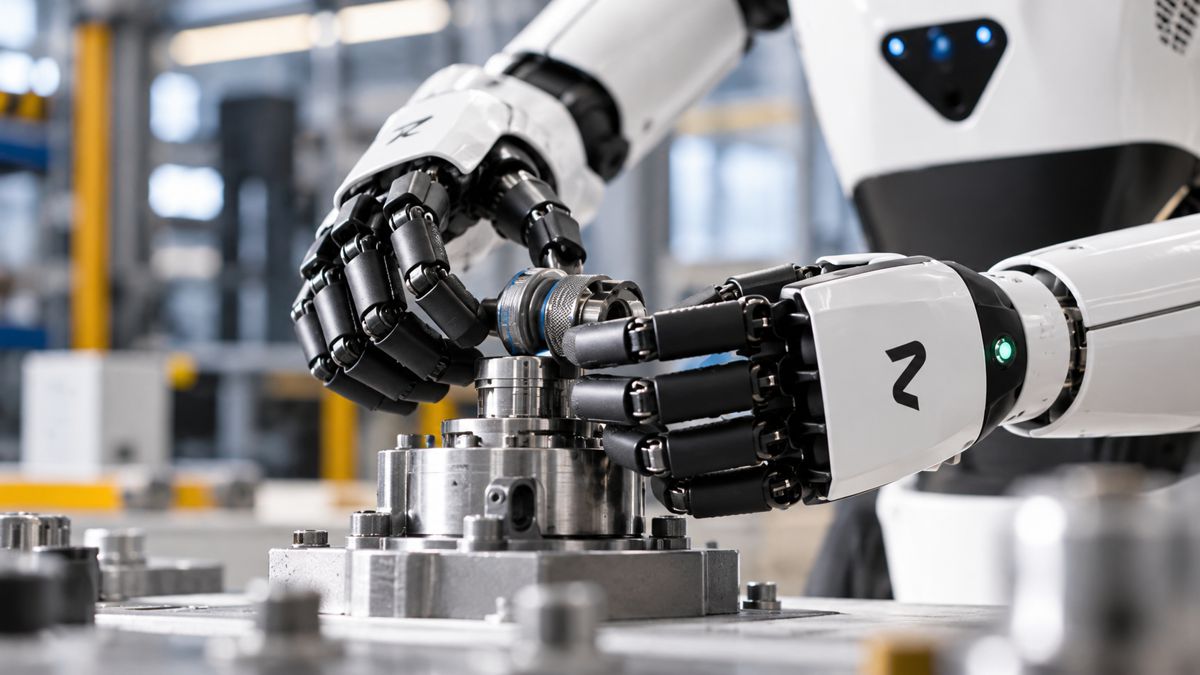
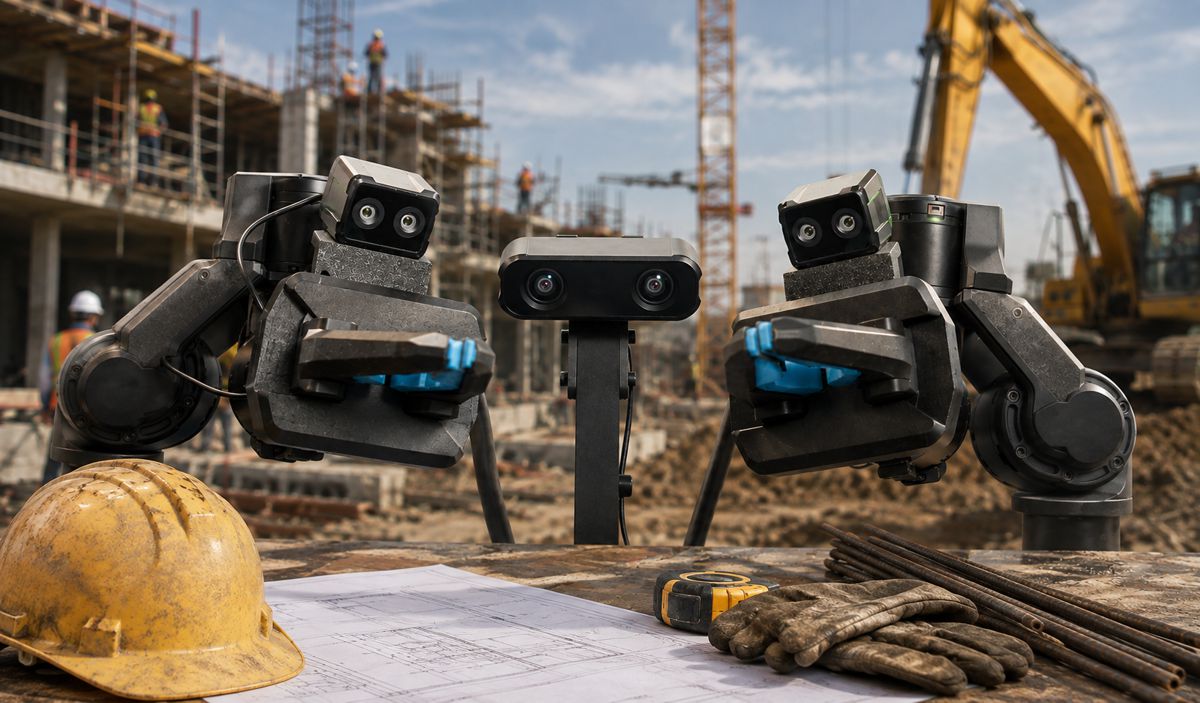
The Workbench and Rivet replace that improvisation with a unified platform built around dual WidowX Pro six-degree-of-freedom arms, onboard NVIDIA Jetson AGX Orin compute, and a factory-calibrated three-camera system assembled entirely from Stereolabs hardware. A centre-mounted ZED X Mini supplies the global scene and stereo-depth context, while a wrist-mounted ZED X Nano on each arm delivers the close-range view of gripper and object that imitation-learning policies rely on for fine manipulation.
The engineering choices underneath that architecture are what turn it into training-grade capture rather than a tidy demonstration. The ZED X Nano uses dual global-shutter sensors that record at up to 60 frames per second without the motion blur of rolling-shutter USB cameras, resolves geometry from as close as three centimetres, and connects over GMSL2 with locking, interference-resistant cabling that keeps all three cameras deterministically synchronised on the Jetson.
That synchronisation allows a team to record, encode and run inference at the same time without frames silently dropping mid-episode, and native support for ROS 2 and NVIDIA Isaac Sim and Isaac Lab means each recording feeds directly into imitation learning, reinforcement learning and sim-to-real workflows. Matt Trossen, chief executive of Trossen Robotics, framed the shift in supply terms, arguing that “The Physical AI community is migrating to GMSL2 because USB can’t handle the long cable runs from the end effector to compute that real robots demand. Stereolabs ZED X Nano gives us the signal stability, image quality, and throughput to take Physical AI from the lab into hardened industrial deployments. Teams should spend their time collecting demonstrations and training policies, not integrating and calibrating camera rigs.” The commercial reading is straightforward, because engineering time spent stitching sensors together is time not spent generating the asset that actually has value.
The Sensor Consolidation Wave Behind The Deal
The Trossen integration cannot be read in isolation from the corporate manoeuvring that produced it. Ouster completed its acquisition of Stereolabs on 4 February 2026, paying approximately $35 million in cash and issuing 1.8 million shares, of which 0.7 million release over four years, and folding in a business that had shipped more than 90,000 ZED cameras to over 10,000 customers while remaining EBITDA positive on around $16 million of unaudited 2025 revenue.
The logic Ouster set out was sensor fusion, the argument being that autonomy is increasingly constrained not by any single sensor but by how well lidar and vision work together, and that owning both plus the perception software reduces integration complexity for customers. The deal followed Ouster’s earlier merger with Velodyne and sat alongside other consolidation in the sector, including MicroVision’s acquisition of Luminar’s lidar assets for roughly $33 million, as perception suppliers move up the stack from components towards complete platforms.
For buyers, the practical significance of that consolidation is the prospect of single-source perception and reduced integration risk, at a moment when purchasing power is shifting towards suppliers that can deliver sensing, compute and software as a coherent system.
Stereolabs president Cecile Schmollgruber positioned the Trossen partnership as evidence of that integrated approach, noting that “Trossen has done what few others have: put the camera at the heart of a complete, calibrated data-collection system. The Workbench with Stereolabs ZED X Mini and ZED X Nano turns every demonstration into training-grade data, and that’s what will move Physical AI forward.”
The strategic message for infrastructure and industrial procurement teams is that the sensing layer is no longer a shelf of interchangeable parts. It is becoming a small number of vertically integrated platforms whose data quality, calibration and software support increasingly determine which robotics programmes reach production and which stall.
A Market Pulling Robots Out Of The Laboratory
None of this would carry commercial weight without a market willing to deploy. The demand signal remains strong, with the International Federation of Robotics recording 542,000 industrial robot installations worldwide in 2024, the second highest annual total on record and only marginally below the all-time peak, lifting the global operational stock to roughly 4.66 million units.
The recovery is visible in the United States, where preliminary figures show installations rising 11 per cent to around 38,000 units in 2025 after a softer 2024, and where electronics has overtaken automotive as the leading source of new demand. Set against a global forecast that points towards 575,000 installations in 2025 and beyond 700,000 by 2028, the direction of travel favours suppliers positioned for the next wave of capable, AI-driven machines rather than fixed, single-task automation.
That next wave is what makes hardened, industrial-grade data collection commercially relevant rather than an academic nicety. Events such as Automate 2026 have marked a visible shift of humanoid and manipulation robotics from demonstration towards production, and the constraint on that transition is the ability to teach machines new tasks quickly and reliably.
The same imitation-learning and perception stack that trains bimanual manipulators is the upstream layer on which construction and infrastructure autonomy will ultimately draw, from autonomous plant and jobsite robotics to the safety-critical perception that Ouster already sells into smart infrastructure through products such as its Gemini and Blue City lines.
A data-collection system rugged enough to leave the laboratory, with cabling and synchronisation designed for real machines rather than benchtop prototypes, is therefore a precondition for autonomy scaling into the demanding environments that construction and heavy industry represent.
What Industry Leaders Should Take From This
The clearest lesson for infrastructure owners, equipment manufacturers and investors is that the competitive frontier in Physical AI has moved to the data layer, and that the layer is being captured by integrated hardware and perception platforms rather than by loose collections of parts. Buyers evaluating robotics programmes should scrutinise how training data is generated, calibrated and synchronised, because those characteristics now set the ceiling on policy performance and, by extension, on how well a deployed machine will behave on a live site.
The premium is shifting from raw sensor specifications towards guaranteed data quality delivered as a system, and procurement decisions taken on that basis are likely to age better than those made on component price alone.
For investors, the Ouster and Stereolabs combination is a template worth watching, because it pairs a profitable, cash-generative perception business with a strategic position at the point where robot learning is fed. The wider field of horizontal infrastructure, spanning NVIDIA’s Isaac simulation and robot-learning frameworks, its Jetson edge compute, its Cosmos world foundation models and the calibrated capture hardware that feeds them, is where reusable value and potential lock-in are accumulating across many robot makers at once.
Construction and infrastructure leaders do not need to build robots to be affected by this, since the speed, cost and reliability of the autonomy they eventually buy will be set upstream, in the data-collection supply chain now taking shape. The organisations that understand that dependency early, and that specify for data quality rather than for headline hardware, will be better placed as capable machines move from the residency floor to the construction site.
Key Industry Questions
- Why is data, rather than compute, described as the bottleneck in Physical AI? Compute for training large vision-language-action models is now commercially accessible, and physics simulators can generate millions of episodes cheaply. What has not scaled is high-fidelity real-world interaction data, the paired observations and actions recorded when a physical robot completes a task. Human teleoperation, the highest-quality source, yields only a modest number of clean demonstrations per operator-hour, and industry estimates place the available pool of high-quality interaction data far below the volume required for general-purpose competence. Because policies inherit the flaws of the data they learn from, the practical limit on robot capability is the rate and quality of demonstration capture, not the availability of processing power, which is why data-collection infrastructure has become the strategic chokepoint.
- What advantage does GMSL2 connectivity offer over USB cameras for robot data collection? USB struggles with the long cable runs between a robot’s end effector and its onboard compute, and consumer USB cameras often introduce motion blur, calibration drift and timing inconsistency across multiple views. GMSL2 uses locking, interference-resistant cabling that supports those longer runs while keeping multiple cameras deterministically synchronised on the compute module. In the Trossen Workbench and Rivet, this allows three cameras to record, encode and run inference simultaneously without frames dropping mid-episode. For teams building training datasets, the result is tightly synchronised, multi-view imagery with consistent timing, which is essential for imitation learning where the temporal correspondence between what the robot sees and what it does must be exact.
- What did Ouster gain by acquiring Stereolabs? Ouster acquired a profitable, EBITDA-positive vision and perception business with more than 10,000 customers, over 90,000 shipped ZED cameras and approximately $16 million of unaudited 2025 revenue, for roughly $35 million in cash plus 1.8 million shares. Strategically, the deal moved Ouster beyond digital lidar into a combined sensing and perception platform, allowing it to address sensor fusion, the challenge of making lidar and cameras work together, as a single integrated offering. It broadened Ouster’s addressable market across robotics, industrial automation and smart infrastructure, added software and AI-model capability, and positioned the company as an end-to-end supplier at a time when customers are seeking to simplify system design and move autonomy from pilots into scaled deployment.
- How does synchronised, multi-view data improve robot policy training? Manipulation policies learn from the relationship between what a robot perceives and the actions it takes, so any drift between camera views or between imagery and motion degrades the signal the model receives. A synchronised system that combines a global scene view with close-range wrist views gives the policy both spatial context and the fine detail of grasping, captured with consistent timing and calibration. Adding stereo depth to the standard colour imagery provides geometric information that helps a robot judge distance and contact, which is critical for contact-rich tasks. Cleaner, better-aligned data raises the ceiling on how well a trained policy performs, and reduces the number of demonstrations needed to reach reliable behaviour.
- What does this mean for construction and infrastructure autonomy specifically? Construction firms are unlikely to collect manipulation data themselves, but they will buy the autonomous plant, jobsite robotics and perception systems that this supply chain produces. The speed, cost and reliability of that autonomy are being determined upstream, in how effectively developers can train machines for new tasks. Rugged, industrial-grade data-collection hardware is a precondition for autonomy that works in demanding site conditions rather than only in the laboratory. Perception suppliers such as Ouster already sell into smart infrastructure, and the same imitation-learning stack that trains manipulators underpins the broader push towards autonomous equipment. Infrastructure buyers benefit from understanding that data quality upstream shapes machine reliability downstream.
- Is the industrial robot market genuinely growing, or plateauing? Installations are broadly holding at historically high levels while shifting in character. The International Federation of Robotics recorded 542,000 industrial robot installations in 2024, the second highest total ever and only slightly below the record, with global operational stock reaching around 4.66 million units. United States installations recovered 11 per cent to roughly 38,000 units in 2025, and electronics overtook automotive as the leading demand source. Global installations are forecast to rise to about 575,000 units in 2025 and to exceed 700,000 by 2028. The more significant change is qualitative, as demand moves towards capable, AI-driven and increasingly general-purpose machines, which is exactly the category that depends on the training-data infrastructure now being built.
- Where do NVIDIA’s Isaac Sim and Isaac Lab fit into this picture? Isaac Sim is a GPU-accelerated, physically based simulation environment for designing, testing and generating synthetic training data, while Isaac Lab is a robot-learning framework built on top of it that trains policies using reinforcement and imitation learning at scale. Together they let developers rehearse and refine policies in simulation before deploying to real hardware, then blend that synthetic data with real demonstrations to close the gap between simulation and reality. The Trossen platforms support both natively, alongside ROS 2, so data captured on the hardware flows directly into these workflows. This positions NVIDIA’s stack, from Jetson edge compute to Isaac software and Cosmos world models, as the horizontal infrastructure much of the sector now builds upon.
Strategic Takeaways
- The competitive frontier in Physical AI has moved from models and sensors to the data layer, and calibrated, synchronised capture hardware is becoming as strategically valuable as the policies it trains.
- Buyers should specify robotics and data-collection systems on guaranteed data quality, since synchronisation, calibration and depth fidelity now set the ceiling on how a deployed machine performs, ahead of headline component specifications.
- Sensor consolidation, exemplified by Ouster’s acquisition of Stereolabs and MicroVision’s purchase of Luminar’s lidar assets, is concentrating purchasing power in a small number of vertically integrated perception platforms offering single-source sensing, compute and software.
- The industrial robot market remains in structural growth, with 542,000 installations in 2024 and a United States recovery to around 38,000 units in 2025, but demand is tilting towards capable, AI-driven machines that depend on the emerging training-data supply chain.
- Construction and infrastructure leaders are exposed to this shift even without building robots, because the cost, speed and reliability of the autonomy they eventually procure are being decided upstream in the data-collection infrastructure taking shape now.